Sunday, September 16, 2007

Riot for austerity


So, the Riot for Austerity challenge is to use one tenth of what the average American uses. A pretty extreme challenge, but they're not dogmatic about it as they say:
"the goal is to reach a 90% reduction (or the best each of us can do) *AND KEEP IT THERE* after 1 year."

I don't think we'll ever get to the goal they've set, but we're doing better than 'average' in some respects. They say that the average American household uses 900 kwh of electricity per month. So far this calendar year, we've averaged about 750 kwh per month, even though we've had the central AC on for the last three months. The next couple of months are usually fairly low ones for our electric bills, so that should bring the average down. We've already replaced almost all the lightbulbs with CF ones. My next move to reduce our electricity use will be to buy another indoor drying rack and get a washing line set up to dry laundry outdoors.

Apparently "the average American generates about 4.5 lbs of garbage PER PERSON, PER DAY." I weighed our trash before going to the dump this weekend. I don't usually weigh the trash bag, but I could tell as I lifted the bag that it was a lighter than average trash week. We had 2.5 pounds of trash TOTAL for the four of us for the week. We also had 7.5 pounds of paper recycling, and about 9.5 pounds of plastic and glass recycling. (I forgot to subtract the weight of the container for the glass and plastic so it was probably a little less than 9.5 pounds.) There was some other glass and plastic that was not included because they were returnable bottles with deposits on them. Any food waste that we could put in the compost bin we did, and I didn't weigh that. I'm not sure if it counts as trash anyway, but I suspect the other recycling does because many communities still don't offer recycling opportunities. So I took less than 20 pounds of stuff to the dump/recycling center - about 16% of the 126 pounds of trash the 'average' family of four creates.

There are many areas of our lives that we could make less wasteful, but it looks as though we're off to an OK start.

Friday, September 14, 2007

What a funny-looking donkey!

Several years ago, dear husband and I were driving to see some friends in northern Vermont when I saw an animal at the side of the road. There was a couple who had gotten out of their car who were quite close to it, taking photos. I said, (to my eternal embarrassment), "What a funny-looking donkey!" No, it was NOT a donkey - it was a female moose.


I was confused because I was not that close to the animal but it was standing fairly near to the people who were photographing it and looked pretty tame. So now it's a family joke that I can't identify animals, and even when we see animals like giraffes someone will say: "Ooh, look at the funny-looking donkey!" I can in fact now identify a moose (and a giraffe) quite easily, but I do occasionally have difficulty with other animals. The first time I saw a coyote, I was sure it was a long-legged fox. I knew that coyotes live around here, (I've even heard them howling at night,) but it still seemed wrong that they should. The word 'coyote' always sounds, well, foreign and exotic to me and evokes an image of animals silhouetted on a ridge at sunset somewhere in the wilderness. Maybe I'm just confusing them with wolves. I'm sure (I think) that we don't have any of those around here!

(BTW, the picture above is NOT the moose I saw that day.)

Thursday, September 13, 2007

Bears in the yard

I've been meaning to blog about our bears for a while, but reading this post about a bear in Colorado prompted me to get started on it.

The first time I ever saw a bear near our house it was in the late afternoon when a fairly young bear was wandering down the middle of the road. A car came by and when the driver stopped to get a better look at the bear it climbed a tree in fright. It didn't stay there long though. It seemed to figure out that the car and driver were no immediate threat, and it climbed down again and ran off into the woods.

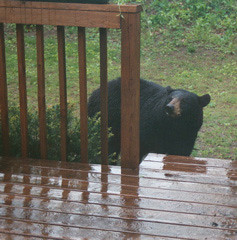
We've seen them quite a few times since, some occasions more memorable than others. There was the time a bear climbed up on the basement hatchway to get at the bird feeder on the kitchen window. We'd removed all the other bird feeders from the yard a couple of weeks earlier after a bear bent the metal poles they were hanging on through 90 degrees. We foolishly figured that if the bear had left the one on the kitchen window alone, then it wouldn't come that close to the house. Wrong! We should have remembered the story (not apocryphal) about a family in town who had left the kitchen door open and a bear wandered right into the house and started ransacking the cupboards! My husband almost had a heart attack. He was standing at the kitchen sink, when suddenly there was a bear right outside the window only a couple of feet in front of him grabbing at the bird feeder. It pulled the feeder off the window, shook out the contents and ate most of them. (Given that it had earned itself little more than a snack I was surprised the bear left so much seed on the ground.) Once it was done emptying the feeder, it seemed to consider coming up on to the deck before wandering off to the neighbor's yard.


(Yes, although black bears are really not very agressive, I was safely inside the house when I took this picture.) We thought the bear had gone, but a few hours later when my husband went to take something out to the compost bin, he surprised the bear coming out from under the deck! It was making itself altogether too much at home for my liking! We never saw it under the deck again, but who knows?

A couple of times since we've been living here, the kids at one of the local elementary schools have had to stay inside the school at recess because there was a bear wandering the grounds. Many of the bears wear radio collars so that the state department of wildlife can track them. One of the kids, seeing the collar wanted to know who the bear belonged to!

The thing is, these bears are not way out in the countryside. Our house is only a couple of miles from the center of town. I've seen a mother bear and cub scampering down a densely populated residential street even closer to the center of town. Apparently, despite the fact that humans have been taking more and more of the bears' habitat for development every year, the black bear population is still growing - from about 100 in the entire state in the 1970's to somewhere around 3,000 now! An orchard where we used to see them when we first lived here is now a housing development. It's sad to think that, despite that, the bears are doing so well that it is actually legal to hunt them and dozens are killed every year for 'sport'. Although I seem to have terrified my brother-in-law in the UK with the thought that we have bears walking through our yard, they are rarely a real nuisance. (There was that one bear though that got drunk in a local orchard on fermented apples and wouldn't leave for a couple of days, but it wasn't in our yard, so I found that entertaining rather than a nuisance!)

Wednesday, August 22, 2007

Proms for 7 year-olds?


Last year I was surprised to hear of graduation ceremonies in the UK for 4 year-olds, so I suppose I shouldn't have been surprised to read this about a prom in South Wales for seven-year olds. At least they changed the cultural context a little for the prom in Rhondda by having a tea party before the disco! What really surprised me was that many of the kids arrived in limos! (At least the photo reveals that they had parents in tow!)

Limos were banned as transportation to the prom at one of the private schools I worked at here in the US because it created a very clear distinction between those who could afford them and those who could not. Instead, the students were offered a choice of restaurants to go to and the school arranged the transportation. Not so 'classy', but for many of these kids a limo was nothing special anyway. In the context of the UK state school system where something like 85% of schools have uniforms that were always supposed to promote a degree of equity, it seems downright wrong to have a prom that encourages people to spend large amounts of money on limos and on prom outfits that will never be worn again. What about the kids on free lunches? I know some of the families were very proud that they 'only' spent £20, but it was an outfit that will probably never be worn again (except for dress-up.) A 'leavers' do', or 'moving up' party would have been just as much fun for the kids I'm sure.

Monday, August 13, 2007

Riot for austerity

riot for austerity
I'm contemplating joining the 'Riot for Austerity'. Not sure how far I'll get, but the goals are worthy ones . . .

More immigration confusion


My parents recently paid us a visit from the UK. The immigration official at the airport told my father that he had a 'problem' because his fingerprint did not match the fingerprint they took when he entered the US last September. After sending him to another official, they decided that they had simply 'confused' my father's fingerprint with my mother's. He was actually expecting to have more of a problem with the fact that they never took his departure card when he left last year, so technically there is no record of him ever having left the country before returning last month . . . They didn't mention that.

And I was SO hoping that the INS' record-keeping had improved since I last had to deal with them :-(

Friday, July 13, 2007

The world's best chocolate


Many years ago someone told me that chocolate in the United States was formulated differently in order to improve its shelf life. I knew it tasted different, although I wasn't sure of the veracity of the claim about shelf life. This week Kim Severson of the New York Times said the world's best candy is British and explains the difference between American and British chocolate:
According to the label, a British Cadbury Dairy Milk bar contains milk, sugar, cocoa mass, cocoa butter, vegetable fat and emulsifiers. The version made by the Hershey Company, which holds the license from Cadbury-Schweppes to produce the candy in the United States under the British company’s direction, starts its ingredient list with sugar. It lists lactose and the emulsifier soy lecithin, which keeps the cocoa butter from separating from the cocoa. The American product also lists “natural and artificial flavorings.”

Apparently the claim about shelf life is true as chcolate bars
from the United Kingdom are made from a better recipe, containing fewer stabilizers. They melt more quickly than a Hershey bar

When I was living in Taiwan I was delighted to discover that much of the candy was made to the British rather than the American formula. I wonder why in a tropical country they felt no need to use a formula for the chocolate bars that would give them a longer shelf life? I would guess it probably has something to do with the proximity of Hong Kong where there were lots of people who were used to the British version of the candy bars.

Sunday, July 01, 2007

Immigration

After spending many thousands of dollars to get a work visa and then a Green Card in order to stay in the United States, it was amazingly simple to become a United States citizen when I finally became eligible.


When I applied for United States citizenship eight years ago I did not need a lawyer to help me, didn't need to take any classes, or study from any books. I think things have become a little tougher since 9/11, but there are lots of free resources such as public library websites or community based organizations. Even the US government provides information along with the application forms. There are plenty of people out there willing to take money to help you become a naturalized citizen, but as far as I know if you've got as far as getting a Green Card, the last step is easy and you really shouldn't need to pay for any help if your English is good enough to read and understand the application form.

I filled out the forms, wrote a check, and posted it all to the relevant address. Shortly afterwards I received a letter from the regional Immigration and Naturalization Service (INS) Office requesting that I report to my 'local' (2 hour drive away) INS Office. The reason: I had been granted permission to remain in the United States as a resident alien 5 years earlier but I had 'never been issued' with a Green Card and so I had 10 days to report to the INS office to rectify the situation. I was rather confused because I could have sworn I HAD a Green Card.

Not only did I have a plastic card with my photo on it that looked just like a Green Card was supposed to (no, it's not green!), but I knew it was a Green Card. How did I know this? Well, firstly, it had been mailed to me in an envelope that had a return address at the INS. Secondly, I had used the card to get in and out of the USA several times with no problems over the previous 5 years. Thirdly, I had gone on a 'backstage tour' at my local INS office just days after receiving my Green Card and one of the officials on the tour had (with my permission) entered my card number into her computer to pull up the INS computer file on me to show other people on the tour what kind of information they had. So I photocopied the back and front of my Green Card and wrote a letter to the regional INS office asking them what this piece of plastic was that had gotten me in and out of the country if it was not a Green Card and could they please reassure me, since I had just applied for citizenship, that my paperwork was in fact in order. I never heard back from them until I got a letter inviting me to the local INS office for my citizenship interview.

It was actually the tour of the immigration office that had made me decide that I would file my application for citizenship the first day I could. As well as pulling up my records on the computer, we asked if they could pull up the records of the 'designated officials' at a local university - people authorized to sign visa paperwork for international students. An international student accepted at an American university needs official paperwork showing that they have been accepted and have proven to the school that they have enough money to survive their course of study. Only a handful of people at any given institution are authorized to sign this paperwork, and their names are on record with the INS as Designated School Officials (DSOs.) So if an immigration official has doubts about the authenticity of an arriving student's paperwork one of the first things they can do is check that the person who signed the forms was in fact authorized to do so. So imagine the university officials' horror when they found that the official INS list of people at their university authorized to sign was TWO years out of date! As far as they knew, they had done everything they needed to to become a DSO, but if an official had questioned paperwork they had signed, a student who was legitimately accepted at their university could be denied entry to the country. Not good!

I also saw people filing paper records at the INS office and remember being told that when those records were needed again it would be impossible to find them unless someone knew the last date on which they had been accessed because that was how they were filed.

Having seen these examples of the INS inefficiency, I was not exactly excited about having to continue to deal with them for any longer than I had to. It is no wonder they have not been able to keep track of potential terrorists. My impression was that the INS were underfunded and understaffed and handicapped by a useless computer system. It was amazing things worked as well as they did. It would be nice to think that things have improved over the intervening years, especially with all the recent discussion about immigration and security, but sadly I doubt it has changed much. There are advantages to being a US citizen rather than a resident alien, but for me one of the biggest advantages is not having to deal with the INS any more.

Tuesday, June 26, 2007

Heatwaves


Watching TV last night, the weather forecaster commented that although today the temperatures would reach the 90's for a second day in a row, we can't talk about a heatwave because there is unlikely to be a third day of high temperatures. A heatwave in New England is defined (by one of the local TV station weather forecasters) as a string of three 90+ degree Fahrenheit (over 32° Celsius) days in a row. Two days of those temperatures would definitely count as a heatwave in the UK.

Some people laugh when people in the UK complain about heatwaves when the temperatures are only in the 70's, (mid 20's Celsius) and you see headlines like "Britain swelters in the seventies." It makes complete sense though that the official definition of a heatwave will vary from place to place. In the Netherlands it's classified a heatwave when there are at least 5 days with a maximum temperature above 25°C (77°F) of which at least 3 days have a maximum temperature above 30°C (86° F). (Source: World Health Organization)

Looking for information on the topic this afternoon, I discovered that depending on where you are in the UK, let alone where you are in the world, the temperature threshold is different. In a large country such as the USA, I would have expected that. 'Hot' weather in New England is not the same as 'hot' in the southern USA. I was surprised to find regional differences in the definition of a heatwave for the UK. The temperatures must be reached on at least two consecutive days and the intervening night.

Scroll down - for some reason the table below has decided it needs lots of personal space and nothing I do will persuade it to move back up the page :-(


Region Threshold temperature
Day max Night min
North East England 28°C / 82.4°F 15°C / 59°F
North West England 30°C / 86°F 15°C / 59°F
Yorkshire and the Humber 29°C / 84°F 15°C / 59°F
East Midlands 30°C / 86°F 15°C / 59°F
West Midlands 30°C / 86°F 15°C / 59°F
East of England 30°C / 86°F 15°C / 59°F
South East England 31°C / 87.8°F 16°C / 60.8°F
London 32°C / 89.6°F 18°C / 64.4°F
South West England 30°C / 86°F 15°C / 59°F
Wales 30°C / 86°F 15°C / 59°F

In the United States, the National Weather Service suggest that a heat advisory be issued when the daytime heat index reaches 40.6°C / 105°F and a night time minimum temperature of 26.7°C / 80°F persists for at least 48 hours. Local definitions are used: in Dallas the medical examiners office define a heatwave as three consecutive days of temperatures over 37.8°C / 100.4°F - that's a good 10 degrees warmer than a New England heatwave.

I wonder how the definitions will change over the next few years as global warming takes effect and heatwaves become more common? Will we simply redefine what a heatwave is?

Monday, June 25, 2007

Marketing math - when 11 equals 15.25


Are they as honest on their 15.25 ounce cans? "Contains only as much corn as the 11 ounce cans." I think not.

Friday, June 01, 2007

Learning about America

in Nelson, New Zealand.

Tuesday, May 22, 2007

God Save my Country


The Little American is practicing for the Memorial Day concert at school on Friday. One of the songs they will be singing is My Country 'Tis of Thee which happens to be sung to exactly the same tune as God Save the Queen. I have now thoroughly confused her as every time she starts to sing it I join in, singing the 'wrong' words :-) She asked me to write down the words for her so that she could teach her classmates to sing God Save the Queen. (Hmm - I can see that going over well at school - NOT!) Unfortunately, she had sung My Country 'Tis of Thee so often that somehow pilgrims kept making their way into God Save the Queen! Now we're both confused!

But did you know that the same tune is used for the national anthems of Norway and Leichtenstein, and used to be used in Switzerland, Prussia and Russia?

Thursday, April 26, 2007

Writers on America


I've just started reading the articles at Writers on America from the US Department of State. It looks as though there is some interesting reading there. I noticed that the site has been translated - but only into Arabic. Clearly a propaganda piece, yet not entirely 'rah-rah'. Julia Alvarez, for example, talks of the difficulties she and her family faced on their arrival in the United States, and I would guess some of the other articles are equally honest about the imperfections of the American 'melting pot'.

Monday, April 16, 2007

Attitude

I remember someone telling me once shortly after I arrived in the US that a big difference between the US and the UK is the can-do attitude over here. If someone in the UK said they were thinking about maybe writing a book, the reaction would be, "What, you?" If someone in the US said the same thing the response would be "Go for it!"

I wonder how much that has changed with bloggers like Tom Reynolds, Petite Anglaise and others getting publishing deals now and becoming celebrities?

Sunday, April 15, 2007

The British Abroad


To balance my earlier post on why some Americans shouldn't be allowed to travel - the British on vacation abroad don't have a particularly good image. Charles Bremner wrote in his Paris Weblog
In the old days, the Americans stood out among the visitors, for dress and behaviour. Now les anglais often draw attention to themselves while the Americans -- on the defensive in France -- try to blend in more.

Magwitch writes :
"unfortunately the most hideous people I’ve ever met when travelling are ignorant, load mouthed Brits who won’t attempt the language, the food or the culture and are generally obnoxious to everyone."

NoJags Neil writes
The perception of the British abroad is not a good one, and the absence of pissed-up promiscuous British twentysomethings on our recent holiday to Egypt was refreshing.


I don't think it's so much the individual Brit abroad, or even small groups, but mostly the larger groups that create this poor image. The chances are much higher that a Brit on a tour versus one travelling independently will be an obnoxious twit. Ditto for other nationalities.


The dark socks with sandals - such an attractive look - not! And the lobster-colored skin - de rigeur when travelling to warmer climes. Do men really still wear knotted hankies on their heads though? I doubt it nowadays, though I think I remember my grandfather doing that when sitting out in the sun in his garden.

Adam Dalton has written a far more comprehensive article about the British tourist overseas than I have time to attempt: The British Abroad - Not a Pretty Sight!

Saturday, April 07, 2007

Easter


I don't remember a bunny ever having anything to do with Easter when I was growing up. He may have shown up at other people's houses, but certainly not ours, where Easter was a religious holiday. We got chocolate Easter eggs, but from our parents and grandparents rather than a bunny, and there were no Easter egg hunts. Dear Husband grew up with different traditions, although Easter was still definitely a religious holiday for his family. The Easter bunny always brought him and his brother things like balsa wood airplanes or a kite - toys with an outdoor focus. They always got a chocolate rabbit too. I would bet they got Peeps most years too as my father-in-law loves them. Sometimes the bunny brought them a toothbrush!

For the moment, the Little Americans in the house think Easter is all about the rabbit. The Little American probably knows more about Passover traditions than the religious nature of Easter even though she does have a book of Bible stories that she enjoys reading, and often reads the stories aloud to her brother.

As the kids were going to bed tonight they wanted to be sure that their baskets were put out in the living room and some carrots left for the bunny. They then had a very intense discussion with each other about how the bunny is going to get into the house. "Well we don't have a chimney, so he can't get in that way." "He can't come in through the door because the alarm would go off. He must come in through the window." They are evidently unaware of the concept of a motion-activated alarm or what the little boxes with the red lights in the corners of the rooms are for. They also haven't noticed that all the windows are locked. Hmm - I'd better go and check and make sure they haven't UNlocked any! I wouldn't put it past them!

I've just finished filling plastic eggs to hide around the back yard in the morning. The raccoons would find them if we put them out now! I don't know what they'd make of plastic eggs as opposed to the real thing (which I know they love), but I'm sure they'd check them out pretty thoroughly!

Dear Husband is looking over my shoulder and comments that he had contemplated going outside to collect some of the wild rabbit droppings from the lawn and leaving them next to the baskets in the living room! Fortunately, he decided not to bother.

Sunday, February 18, 2007

A nation of wasteful abundance


I remember being shocked in my first few days at university here to see the amount of food and paper serviettes (napkins) that were wasted at every mealtime in the Dining Commons on campus. It seemed as though everyone took half a dozen napkins instead of just one. Lots of people took far more food than they could possibly eat and then threw it away. My culture shock at this was nothing however compared to Mark Mathabane's. Mark is about my age but grew up in the black township of Alexandra in South Africa under the apartheid regime. He ended up studying in the United States too. In his book Kaffir Boy in America (sequel to Kaffir Boy , the story of his childhood in South Africa) he writes of his first few years in the United States. He too was (unfavorably) impressed by the amount of wasted food. His shock was clearly far greater than mine of course. I got over it to some extent but the memory of the shock is still there.

Occasionally as I look at our well-stocked pantry and wonder what we should have for dinner, I think how spoiled we are. We bulk buy because it's convenient. We can store far more food than we would be able to in the typical English house. Although we might not be eating what we wanted, we would have enough food for several weeks should something happen to stop us from getting to the stores.

It's not only food, but all the other 'stuff' in our lives that is embarrassingly abundant. I assuage my guilt a little by trying to throw as little out as possible. No, that does not mean hoarding! We recycle paper, glass, and plastic, and would even if our town did not require it. I pass on outgrown kids clothing to friends with smaller children, or to local agencies that collect such stuff. Recently we have used Freecycle as a way of passing things on that we have no use for anymore. (Freecycle exists in many other countries including in the UK too.) It's a small thing to do, but why throw things out when someone might be happy to reuse them? Enjoy the abundance, but cut down on the waste!

Saturday, February 03, 2007

37% American

My quiz results from the blogthings "How American Are You?" quiz:

You Are 37% American

America: You don't love it or want to leave it.
But you wouldn't mind giving it an extreme make over.

Dear Husband (who was born and raised here) scored 44%.
I passed the blogthings US Citizenship test though:
You Passed the US Citizenship Test

Congratulations - you got 7 out of 10 correct!

Then again, blogthings says I belong in the UK:
You Belong in the UK

Blimey!
A little proper, a little saucy.
You're so witty and charming...
No one notices your curry breath

Friday, February 02, 2007

Chewing gum


Growing up in the UK, I always thought of chewing gum as quintessentially American. It was another of those nasty American habits, like not pronouncing words properly, that marked one as boorish and uncultured. I knew people who chewed gum, but it wasn't something I did. Chewing without eating seemed rather pointless and, anyway, my dentist had advised me not to bother as I had some problems with my jaw that he said chewing gum would aggravate. I remember noticing that French teenagers seemed to chew gum more often than the English did. (They smoked more too.)

My dislike of gum is apparently typically British - as Cadbury's starts a large advertising campaign to launch Trident gum onto the British market, the BBC reported today:

most people think it looks "common" and "uncouth", according to government research. And that includes the 50% of the population who chew it.
My issue with gum chewers when I was in school was the fact that they didn't seem to know how to dispose of their gum. Of course one reason my peers didn't dispose of their gum in more appropriate ways was because they weren't supposed to be chewing it in the first place. I worked for some years in a school where gum chewing was not allowed and the teachers seemed to be fighting a losing battle to stop the kids from chewing gum or to get them to throw it in a trash can when they had finished chewing it. Then I worked at a school where it was allowed unless individual teachers asked students not to chew gum in their classes. There seemed to be very little problem with finding it in places it shouldn't have been. Then a new regime changed the rules - no more gum permitted, and suddenly there was gum on the ground outside buildings, under desks, stuck on the walls . . .

Just as I've become used to American pronunciation, I've become used to seeing people chew gum without judging their social worth. I still don't do it myself, but I really don't think more people in the UK chewing gum indicates the decline in standards that some people over there are bemoaning.

Thursday, January 25, 2007

Citizenship tests


I wrote back in July 2006 that I only scored 65% on the "Do you have what it takes to become a citizen?" quiz about American citizenship. There's a UK equivalent online too. Some of the things you're expected to know for the UK test don't seem particularly useful pieces of cultural knowledge, which I would have thought was the point of the test. I scored 85% on it anyway - better than on the American one, although I admit I guessed at the answers to some of the questions that I got right! Maybe I am still more British than American!

Related Posts with Thumbnails